
A sermon on Matthew 28:1-10; Genesis 1:26-27; and 1 Corinthians 15: 35-38, 42-55 by Nathan Nettleton
The song we just sang is like an earthquake shaking us out of the silence, isn’t it? And that fits the gospel account we heard: “Suddenly there was a great earthquake; for an angel of the Lord came and rolled back the stone … and the guards shook and fell down like dead men.”
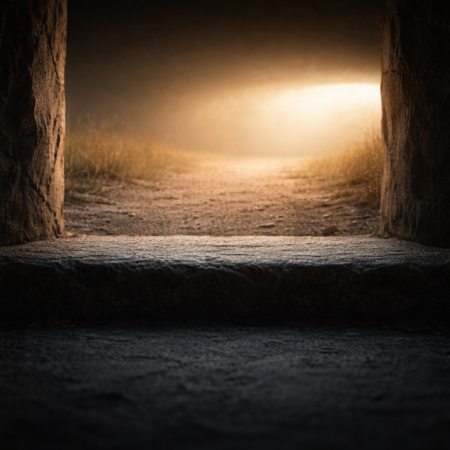
Nothing less than an earthquake could convey the shaking of the cosmos that Matthew wants us to see. And what we see or don’t see is at the heart of the story. The guards had been posted to ensure no one saw anything, but when the tomb is shaken open, they collapse and see nothing. The women who the guards should have prevented from seeing, they see. “Come and see the place where he lay,” says the angel. “He has gone ahead to Galilee where you will see him.” “Come and see. Go and you will see.”
What will we see? What does it mean to really see? What is worth seeing, and what does it mean to be something worth seeing?
What do we see in one another? What do others see in us?
Our first reading tonight reminded us that we human beings were created in the image of God. It is the very first thing we are told about human beings — we are made to be bearers of the image of God. In the Greek version of the Hebrew scriptures – the one most quoted by the New Testament writers – the word we translate as ‘image’ is actually the word ‘icon’. It was a profoundly meaningful biblical word long before anyone picked up a paintbrush. We were created to be icons of God, to be visible living representations of God in the world. And we are called to see one another as icons of God. That’s something worth seeing.
Our liturgy tonight has been taking us on a journey from creation to resurrection, with the light growing all the time — the light that comes into the world and lights up the truth of who we are and whose image we are called to bear.
Imagine if the whole world could live up to its calling to be windows into God’s life, and to see God’s image in one another. What a difference it would make. Surely wars would cease if we knew that our bombs were aimed at living icons of God.
But how can the world ever see that vision? Tonight we are gathered to celebrate the answer to that question – the resurrection of Jesus and its earthquake-like shaking of our world and our lives.
In the reading we heard from his letter to the Corinthians, the Apostle Paul argued that questions about the biology of resurrection completely miss the point. If you want to know what sort of body you will have in the resurrection you’ll have to wait and find out, he says. But if you want to know whose image you will be raised in, look into the empty tomb and you might catch a glimpse of him, as he leads us off towards Galilee and on to the ends of the earth.
Paul contrasts Adam, the person of dust, with Jesus, the person of heaven, and he says, “Just as we have borne the image of the one from dust, we will also bear the image of the one from heaven.” He’s using that word ‘icon’ twice more here. We were icons of the one from dust; we will be icons of the one from heaven.
But if Genesis says we were created as icons of God, why is Paul saying we’ve been icons of Adam? Well, it is probably entirely possible to be both at once — anyone who prays with icons will tell you that you can come back to the same icon and see something entirely different.
But there is more to it than that. If we were icons of dust, it was because we were looking at and modelling ourselves on icons of dust. But in the resurrection, our gaze is redirected to the perfect model. Paul speaks of this using the same word again in one of the best known lines in his letter to the Colossians (1:15) — “Christ is the icon of the invisible God, the firstborn of all creation.” The risen Christ is an icon of the invisible God, and as our gaze is drawn to him, we begin to be re-formed in his image, and so become icons that point to him who is the perfect icon of God.
The first Easter icon is actually the empty tomb. That is where the women in our gospel account were first directed by the angel to direct their gaze. Why? Not because the tomb was to become an object of their devotion, but because it could draw their gaze on further, beyond the tomb, and out onto the road where the risen Jesus would be encountered.
The women don’t see the resurrection itself, but as they look on its aftermath, they are drawn into the mystery of the resurrection, and are opened up to the encounter that is beckoning them along the path.
This is precisely what this biblical concept of the icon is about. Icons never perfectly show the thing itself. Whether they are living icons, painted icons, or natural landscape icons like the empty tomb, icons only show traces, glimpses, a breadcrumb trail. And it is as we follow those tracks and traces that we are drawn into the real thing, the living encounter with the risen Christ. And that encounter will so change us, that when others look at us, their gaze will be drawn beyond us and towards Jesus, who is in turn a living icon of God.
We will be reaching out our hands for this reality shortly as we receive another icon, the eucharistic bread shared by our risen Lord at his table. “Let us receive what we are, let us become what we receive,” we say. We receive an icon of God that we may become an icon of God. It is a reality and an invitation — an invitation to us as individuals but even more to us as a community, as a congregation. So what might that look like?
If we overthink it, it will feel impossibly beyond us. But that would probably be to misunderstand the nature of the call. An icon does not pretend to be the real thing, it is a trace, a sign, a glimpse. That’s all we need to be. Whether it is the empty tomb, or the broken bread, or a devotional painting, or your acts of compassion and care, or indeed our church — it is not itself the reality of God, and it shouldn’t be mistaken for the reality of God. But as a living icon, we can be something that gives the world around us a glimpse into the life of God. We can be something that helps others to see traces of what God is doing.
For that to become increasingly true, we need to be following those tracks and traces ourselves. As we stand with those women on that Sunday morning and gaze into the empty tomb; as we hurry from the tomb with them and run into the risen Jesus, and take hold of his feet and worship him; as we take to the road to Galilee and then on to the ends of the earth, following wherever the tracks and traces lead; as we continue to live that story and become that story, we will become a visible image of that story, a living icon of resurrection life, open and easily readable by those who have eyes to see.
Of course, I’m not saying that it will just happen, and that we don’t have to do anything or even think about it. Following the tracks and traces of our risen Lord is a call we have to engage with, and it will continue to ask new things of us, individually and together. But what I am saying is that it’s not a program, a kind of five universal steps that we all have to buy into to show Jesus to the world.
The truth is that different congregations can appear to be going in radically different directions but both be faithfully following the tracks and traces of the risen Christ who is leading them on. We look for the tracks and traces of the risen Christ in our differing contexts and in the contexts of the times we are living through.
I’ve spoken several times about Bishop Malkhaz’s vision of responding to events of ugliness with projects of beauty. It is closely related to this vision of becoming living icons of the risen Christ. People are not going to see the astonishing love and forgiveness of the risen Christ in us if what they see is a belligerent rage against the ugliness and all who are entangled in it. But they will see it if we are boldly living a beautiful alternative to the ugliness.
You and I can’t halt the current wars where ugliness meets ugliness and continues to multiply, but we can be creators of beauty and love and resurrection life on our own local scale. You may well encounter refugees who have fled those wars, and then your small scale acts of beauty and the large scale need of a war-torn world may indeed overlap, and in the overlap there will be something worth seeing, something of true beauty — tracks and traces of the risen Christ; all the ingredients of a true living icon.
As we come to the table shortly, we will be reminded again that it “is the table where our risen Lord opens our eyes to his presence in all the things of earth.” And if we receive there what we are, and become what we receive, we too will become more and more a beautiful icon through which the eyes of others are opened and drawn to the presence of God in all the things of earth.