
A sermon on Isaiah 60:1-6 & Matthew 2:1-12 by Nathan Nettleton
A video recording of the whole liturgy, including this sermon, is available here.
Arise, shine; for your light has come,
and the glory of the LORD has risen upon you.
… Nations shall come to your light,
and kings to the brightness of your dawn.”
Tonight we celebrate the Feast of Epiphany, a celebration of the revelation of Jesus as the Light of God shining into the world’s darkness, bringing life and hope to all peoples everywhere. If the word “epiphany” is not familiar to you, it is very close in meaning to revelation, or enlightenment. It is not only used in religious contexts. You sometimes hear people talking about “having an epiphany”, a sudden moment of enlightenment when some previously obscure reality became crystal clear to them. If they don’t use the word, they might instead describe it as the moment when “the lights came on.”
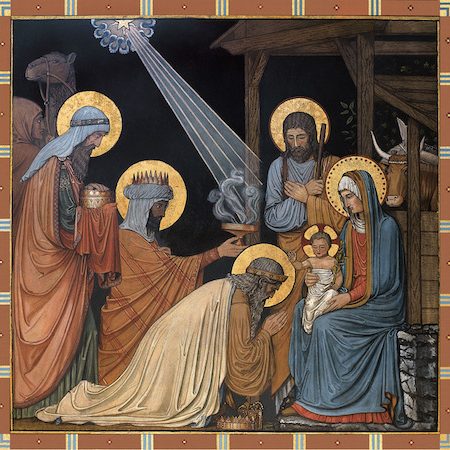
In Western Christian traditions, the Feast of Epiphany is most associated with tonight’s story of the visit of the Magi to the infant Jesus. In the Eastern Christian traditions, it is more associated with stories of the baptism of Jesus, which we will hear this coming Sunday. Both stories are seen as moments when “the lights came on” and people began to realise who Jesus really was.
The Jewish festival of Hanukkah, which is also a festival of light, has suddenly become much better known here in Australia, because the racist massacre at Bondi Beach last month deliberately targeted Jews on the first day of Hanukkah. There is no historical relationship between Epiphany and Hanukkah, but they do share this theme of light coming into the world, and they occur at a similar time of year. Some early church documents even describe them as having exactly the same dates, though that’s certainly not the case now.
What I want to say about Epiphany can, I think, be helpfully illustrated with a comparison to Hanukkah. You see, if you ask two Jews what Hanukkah means, you might get two quite different answers. Historically, Hanukkah commemorates the rededication of the Second Temple in Jerusalem, in 164 B.C. after Jewish forces recaptured it from a Greek empire that had imposed an assimilation policy that sought to eliminate Jewish distinctiveness. If your Bible contains the section of deutero-canonical books, you’ll find the story in the Books of the Maccabees.
But when describing the meaning of Hanukkah today, some Jews will emphasise the Jewish military victory, and others will emphasise the importance of the ritual lighting of the eight candles as a symbol of spiritual light, a ritual that commemorates a miraculous sign during the rededication of the temple when a one-day supply of lamp oil miraculously kept the flame alight for eight days. The emphasis on the Jewish military victory is particularly associated with Israeli nationalism, also known as Zionism, while the emphasis on the temple and its lamps is associated with an approach to Judaism focussing more on faith and spirituality.
Some Jewish writers (see this excellent recent article for example) discuss this as an example of “the ways in which modern Jews pick and choose from the well of tradition to construct a form of Jewishness they feel is authentic.”
We Christians, of course, do the same thing with our traditions, and it seems to me that Epiphany is a good example. You see, what I want to emphasise about Epiphany would be refuted by many other Christians using exactly the same biblical texts that we heard tonight. So I have to acknowledge that what I want to say is not irrefutable, and that it is an example of me picking and choosing between different understandings. The thing is that religious picking and choosing is unavoidable, so the important thing is to acknowledge that we are doing it and to be as thoughtful and honest as we can about the criteria we are using in our choices.
What I want to argue tonight is that the Epiphany stories lead towards a more generous view of people of other faiths and other backgrounds, and encourage us to see that, since God’s light can be seen in all the world, non-Christians will often have recognised and understood spiritual truths that we can humbly receive from them as we seek to be better followers of Jesus.
There will however be others who will want to argue the opposite, and will point out that the foreign mystics known as the Magi are honoured in this story only because they “came to Jesus” as the ultimate light and truth. And when I quote our reading from the prophet Isaiah to talk about the light of God shining into the darkness of the whole world, they will come back at me by pointing out that the text addresses Jerusalem and says “Nations shall come to your light, and kings to the brightness of your dawn.” You can legitimately read that in a more tribal way as implying that any exchange of faith is all one way traffic, and you could do the same with the Apostle Paul’s descriptions of his ministry among the gentiles.
So yes, I’m picking and choosing here, but in doing so I am seeking to read as a follower of Jesus and be true to the ways he picked and chose from the competing versions of the faith that he was presented with. As followers of Jesus we seek to read the whole Bible through the lens of the example of the life, teachings and attitudes of Jesus. Now, of course, Jesus was no more than two years old in this story of the Magi, so I’m not claiming that there is much of his life, teachings or attitudes depicted here. Instead I’m attempting to read and interpret this story through the wider gospel portrayal of who he was and what he was on about.
What is irrefutable is that, as this story tells it, the visiting magi had more insight into who Jesus was and what he meant than did the local Jewish priests and theologians. And Matthew’s gospel is addressed to a predominantly Jewish readership, so he is saying that the magi got it before our side did.
We have no idea exactly who or what the magi were, or even how many there were. The idea that there were three comes from the three gifts that they brought, but three gifts could just as easily be brought by two magi or fifteen magi. They are sometimes described as kings, but there’s no real evidence for that. The text doesn’t even mention camels, but that’s at least much more plausible. What we do know of them from the text is that they came from “the East”, which probably means modern day Iran or Iraq, and that they studied the stars and ascribed spiritual meaning to what they saw there. That could point to them being Zoroastrian priests, but there are other contenders too. It is probably safest to just describe them as foreign mystics.
They represent both non-Jewish ethnicities and non-Jewish spirituality or religion, and so Matthew’s point is very clear: these strangers from outside our ethnic group and outside our faith realised that Jesus was important before we did. That’s a pretty shocking claim to either Jews or Christians, because we have had a tendency to assume that we’ve got a monopoly on the truth about God and even a monopoly on God’s love and acceptance. Matthew seems intent on questioning such assumptions. Genuine God-given epiphanies can come to outsiders too, and when they do, we need to have the humility to listen and learn from them.
My friend Malkhaz, one the Baptist bishops in Georgia, tells me that when they were setting up the Peace Project that houses a church, a synagogue, and a mosque under the one roof, some of the local Jews and Muslims were suspicious that his agenda was to try to convert them to Christianity. In light of Christian history, it is an understandable suspicion.
But Malkhaz was adamant that it was no such thing. Instead he saw it as a place of respectful dialogue and learning, of the bringing together of gifts with the aim of building one another up in the practice of our respective faiths. He said to his Jewish and Muslim partners, “I want to learn whatever you can teach me from your traditions that will help me to become a better Christian, and I pray that there might be things I can share from my tradition that will help you to become better Jews and better Muslims.”
I think that that is very much in the spirit of this story of the Eastern mystics visiting the infant Jesus. The gifts they came bearing were not only gold, frankincense, and myrrh, but religious insight and understanding. They had an epiphany to share, and the priests and theologians on our side hadn’t twigged to it themselves. They needed to listen and learn, but they missed it.
Malkhaz has been encouraging me to think about whether we could do something like the Peace Project here, and given that he said that it was born out of a desire to create a project of beauty that would counteract an ugly rise of anti-semitism and Islamaphobia, the post-Bondi climate here has pushed his urging closer to the front of my mind. I did point out to him that we no longer even have a roof to bring things together under, but I have started to wonder whether our expertise in online prayer might be a gift that might be welcomed by some in other faith traditions.
Perhaps we could help create an online space where a single website contained doorways into online daily prayer gatherings in several different faith traditions, and which also facilitated opportunities for learning and dialogue between the groups. The idea is just a seed at the moment, and it might come to nothing, but the aftermath of the Bondi massacre has me wondering whether this idea might prove to be something of an epiphany.
Whether or not it does, or whether something else quite different might emerge, I do believe that the idea is in the spirit of this celebration of Epiphany. The light of God shines into all the world, and we have no monopoly on the capacity to see it and comprehend what it means. So let’s have the generosity and humility to welcome the gifts of light and truth, however much we might be surprised by who comes bearing them.