
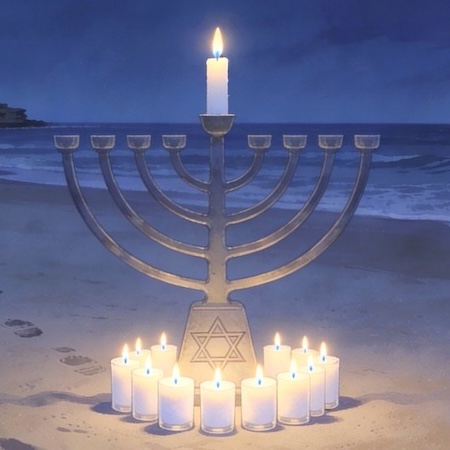
A sermon preached by Nathan Nettleton on 21 December 2025 responding to the Bondi Beach Massacre
A video recording of the whole liturgy, including this sermon, is available here.
This is a difficult week to be preaching. It’s been a difficult week, full stop. The horrifying anti-semitic massacre at Bondi Beach last Sunday night hangs heavy on our hearts and over our whole country, and with added complexity for people of faith, since religious identity was part of the storyline. There are factors that create real confusion for many of us in this, and we’re having trouble unravelling the complexities and making sense of our own reactions. I know this is not just me, because several of you have called me for help in trying to think it through, and I know that if it is some of you, it will be more of you. So it feels like it would be pastorally negligent not to address those questions tonight.
But as usually happens, addressing such things is complicated for a preacher, and not only because I’m in shock too, and having just as much trouble as anyone else sorting out my reactions. It is further complicated by being juxtaposed against preparations for Christmas, against the blessing of the children rite that will be following immediately after this sermon, and against a set of Bible readings chosen for this fourth Sunday of Advent with no immediately obvious relevance to what happened last Sunday.
No immediate relevance, but ….
These readings we heard tonight are all intensely Jewish, and grappling with their Jewishness seems all the more important this week. Our reading from the prophet Isaiah (7:10-16) speaks of another time when the Jewish people felt very much under threat. The psalm we sang in response (Psalm 80) spoke of tears and being scorned by enemies, and although it is not traditionally associated with the present Jewish festival of Hanukkah, its refrain appealing for God’s light to shine on us echoes similar themes. In our reading from his letter to the Romans (1:1-7), Paul speaks of God’s promises through the ancient Jewish prophets, and reminds us of Jesus being descended from King David as he speaks of the relationship between Jews and non-Jews. And the account of Jesus’s conception that we heard from Matthew’s gospel (1:18-25) is also quoting the old Jewish prophets and presenting us a very Jewish picture of domestic life and family concerns.
All of which does, in strange ways, bump us into some of the issues that make it so hard for us to untangle our complex reactions. We know that this week has to be all about sorrow and compassion and solidarity and support. The message I circulated from Bishop Malkhaz expressed all that beautifully, and I want to be able to immediately say the same things, but I find myself unable to arrive there without first struggling my way through some inner conflict. Some of you have told me that that’s you too. And while there is a clear risk in even admitting to being conflicted in these days of performative purity, we probably have to face up to it in order to be able to engage our compassion properly, and so I hope this sermon can help us navigate that journey.
Let me take you off on a couple of strange tangents before circling back in what, I hope, will be a helpful way.
When I was in Georgia in August, one of the things I noticed was the diversity and complexity of people’s feelings towards Russians at a time when their country is feeling very much under threat. Some people just hated all Russians and everything Russian with a fierce anger. Other people had the capacity to distinguish between the Russian political and military regime, and the ordinary Russian people. They would say things like, “Russians who don’t support what their government is doing to its neighbours are absolutely welcome here.” I noticed that it takes a greater maturity, and a greater willingness to work at it, to make that distinction. Simple hatred and hostility is much easier.
Strange tangent number 2. Nowadays, events like this massacre always spawn a whole lot of online conspiracy theories and misinformation. One of the examples has been social media threads denying that the man who charged at and disarmed one of the shooters was a Syrian Muslim immigrant named Ahmed Al Ahmed, and claiming instead that it was a “born and bred Sydneysider” with the good Anglo name of Edward Crabtree.
Why? Well, if you are one of those who want to use the identity of the shooters to fuel further hostility towards Muslims and attacks on immigration from Islamic countries, it is gallingly inconvenient to also have a Muslim immigrant as one of the heroes of the story. And so, like some of the people in Georgia, when the complexity of real life conflicts with our desire for a simple division of “us” who are good and “them” who are bad, we can refuse to acknowledge the complexity and even manufacture lies to cover it up. I think we have all felt this tendency, at least sometimes, not because we are intentionally racist, but because the alternative takes so much more effort.
Now, let me try to connect that idea back through our Bible readings and then on through to the aftermath of the Bondi massacre.
As I said, the Apostle Paul emphasises that Jesus “was descended from King David according to the flesh”, and we are reminded of that again in our gospel reading when the angel addresses Joseph as “Joseph, son of David.” Put simply, Jesus was born and lived as a Jew. And in this messy story of grappling with his pre-marital conception, we are witnessing the life of a Palestinian Jewish couple and their village grappling with who’s good and who’s bad and the difficulty of getting real life to fit neatly into those categories.
But this thorough-going Jewishness of the Jesus stories has been another inconvenient truth for many Christians, especially when we have had trouble dealing with any level of complexity. As Christianity shifted from being majority Jewish to majority Gentile, the othering kicked in, and we tried to claim Jesus as one of “us”, and paint the Jews as the perfidious “them” who killed him.
There have been theological movements that have promoted the idea of a “universal Christ,” a kind of generic being floating above all particulars of history, culture or place. Their goal is to make Jesus more universally relatable to all the earth and its inhabitants, and while I appreciate the positive side of that idea, we have to reckon with the inconvenient truth that its popularity in Nazi Germany shows how stripping Jesus of minority particularities such as his Jewishness might leave minorities more vulnerable to being othered and persecuted.
If we are to believe that God truly took flesh in Jesus, we have to reckon with what some call the scandal of particularity. None of us can say that when God took flesh, he was just like me, because Jesus was a particular human with a whole set of particular attributes. He was a brown-skinned, male, working class, educated, Palestinian Jew. And when we try to erase the attributes that are off-putting to us in favour of a more universally relatable Jesus, we’re actually doing the same attempted erasure that those who invented Edward Crabtree are doing.
But this scandal-of-particularity thing also sneaks up on us in other directions, and I’ve noticed that it has been tripping me up as I’ve tried to process my reactions to the Bondi massacre. Some of you have told me about the same thing.
Logically, we all know that none of the individuals who were killed or injured or traumatised in Sunday’s shooting deserved what happened to them. They were innocent people gathered to celebrate an ancient religious festivity, just as we expect to be doing this week, and they were massacred by two men full of senseless hate. We know that, and we know that the victims deserve our unqualified love and compassion and care.
But there is this weird dysfunctional thing that happens in my head. The particularity thing goes haywire, and points out to me that these victims share some ethnic and religious particularities with the Israeli politicians and the Israeli military leaders who have been perpetrating atrocities in the Palestinian territories.
For the past two years in particular, I’ve gotten used to a narrative in which those perpetrating the majority of the terror have been Israeli Jews. So suddenly my brain goes into shock, and doesn’t immediately know how to think two things at once. The primitive animal part of our brains which is always the first to kick in in a crisis wants simplicity and clarity. They’re all either totally good or totally bad. In shock, our brains don’t handle complexity well.
But the scary thing is that I’m recognising that it is not only in the initial state of shock that I struggle with such thoughts. The internal conflict continues, and I need to face up to that and work out what it is. What is going on?
Something in my brain thinks there is a connection between those who are massacring in Gaza and those who were massacred at Bondi, but the truth is that there is no connection other than their religious and racial identity. Of course some of them might have some ideological connections too, but I don’t know that. The only connection I know about is that they have the same ethnic/religious label. So if something inside of me wants to withhold or qualify my compassion for the Bondi victims because of that connection, that thing inside me can only be racism. Anti-semitism, yes, but anti-semitism is just racism towards one particular ethnicity.
If those gunmen had turned up at the MCG and massacred a crowd of Anglo-Aussies and said that it was in response to Australia’s inhumane treatment of Asylum Seekers in remote detention centres, we would all instinctively recognise the injustice of linking those sports fans to the political overlords who design our immigration detention system. We’d recognise that as racial profiling.
But the inner conflict I’ve sensed in myself this week is actually exactly the same thing. It wants to “explain” and “understand” a massacre of Jews as though holding Sydney Jews accountable for Netanyahu’s atrocities made sense. It makes me feel like somehow I would be being unfaithful to the Palestinian victims if I feel too sorry for these victims here.
Whenever I find myself doing that, connecting the guilty and the innocent based solely on some shared identity particulars, what I am seeing in myself is racism. It is a corrupt and immature resistance to accepting and processing complexity. It is sin. And I need to confess it and seek God’s help to eradicate it from my heart.
In order to be the loving and compassionate person who Jesus calls me to be, I need to get past this streak of racism, and see every individual person through their connection to the image of God, a connection that unites us all in one common humanity. One thing that Christianity, Judaism and Islam hold in common is the imperative to love our neighbours as ourselves. As an absolute minimum, love requires us to do away with hate, even towards those we believe to be perpetrators. Anytime that anyone starts expressing hatred towards another in the name of Christianity, Judaism or Islam, they are thoroughly misunderstanding or betraying their faith. Love triumphing over hate is the bottom line in all three faith traditions. The special children’s rite we will observe in a few minutes is part of teaching our children the ways of this fundamental love.
Every precious life that was lost on that beach last Sunday was as loved and cherished by God as any of us. Until we recognise that Emmanuel – God with us – was with them bleeding on the sand, we’ll also be unable to properly recognise God with us in broken bread and poured wine at the Lord’s Table.
I need to wrap this up, but I want to briefly acknowledge two more aspects of the confusion that I’ve experienced and that some of you have reported to me.
Firstly, it is one thing to know that this week is a time for expressing our grief about Bondi, not for doubling down on our anger about Gaza, but that is made so much harder when the first person to politicise it is Benjamin Netanyahu. In blaming the massacre on Australia’s recognition of a Palestinian state, his agenda, as always, is to try to force us into avoiding complex thinking and retreat back into dangerous all-or-nothing simplifications. He wants to prevent us from caring about two sets of victims at the same time, and force us to take one side or the other. He wants to exploit this massacre to give licence to Israel to massacre its chosen enemies with impunity. It’s the same racism, but in reverse and backed by one of the most powerful militaries in the world. It is very hard to do, but we need to resist the urge to reciprocate, to stoop to his level. Jesus calls us to do better.
Secondly, there is another prevalent form of this inability to process complexity in the aftermath of this massacre. Simplistic explanations. We are hearing all sort of statements like “this happened because the government hasn’t adequately responded to the report it commissioned on anti-semitism”, or “this could have been prevented if we outlawed guns completely.” Yes, we should do everything we can to minimise the risks, but no government program or law can ever fully eliminate the risk. No social ill has ever been completely eliminated by legislation. The best programs and laws in the world can not ensure that there are not even two people left who are willing to hate and kill. But in shock and grief, we initially see only in absolutes, and we instinctively look for a single source of blame.
The one place we really need to look for blame is in our own hearts, because it is the one place where we personally can begin doing something about it. I’m quite distressed at what I’ve seen in my heart this week. I’ve seen little traces of the same evil that drove those gunmen. But when I see it in my own heart, I can bring it to Jesus for healing, and in that, one heart at a time, lies the salvation of the world.