
A sermon on Jeremiah 1:4-10 by Nathan Nettleton
A video recording of the whole liturgy, including this sermon, is available here.
The story we heard in our first reading tonight, the story of God calling Jeremiah to be a prophet, is a popular reading for ordination services. I think it may have been read at my ordination service, but that’s 31 years ago and I couldn’t find my copy of the order of service, so I’m not sure of my memory on that.
It is perfectly appropriate for ordination services, because the call to ministry is an important part of those services, but it is also important to remember that ordination doesn’t exhaust its relevance. If we only hear it, or only hear it preached on, in ordination services, that context will influence how we hear and understand it. The work of prophesy to which Jeremiah was called is a ministry that Jesus inherited, and which is thus now a ministry of his ongoing body, the whole church. This call is now to us, collectively.
The issue of the ordination service is not the only way in which context might affect the way we hear this passage. I was jolted to an awareness of this during my recent travels.
Until quite recently, most of us have usually heard this story from a place of relative comfort. We have had the privilege of living in a prosperous and peaceful country. Some of that is delusional, because much of our sense of prosperity and peace has been maintained by suppressing and ignoring the voices of the people whose rights and wellbeing were brutally sacrificed in the process. But that doesn’t change my point. As long as we successfully hid that reality from ourselves, we experienced our lives as peaceful and prosperous, and we heard this story from that place.
Heard from that place, this story easily accommodates itself to a tame and domesticated version of the gospel, where no one is asked to change their lives too much, just to believe in Jesus and be nicer as a result. Sometimes this version of the gospel has so little to say about our current lifestyles that it ends up being mostly about a promise of an even better life in heaven when you die.
But context! Jeremiah did not live in comfortable times, and although we may still be reluctant to face up to it, we too are living in increasingly uncomfortable times.
During my recent travels, I visited two countries that were part of the former Soviet Union. I had never been in any of the former Soviet countries before. You may be aware that Vladimir Putin regards the collapse of the Soviet Union as the greatest disaster of the 20th century, and his desire to reestablish what was effectively a Russian empire is no small part of his agenda in Ukraine.
I didn’t visit Ukraine, but I did spend 9 days in Georgia which also shares a border with Russia and has been invaded and partially occupied by Russia. I also spent a couple of days in Uzbekistan which doesn’t have a border with Russia, and so doesn’t feel as immediately under threat, but the people there are fearful for their northern neighbours, Kazakhstan, who are wealthier, share a large border with Russia, and could certainly be next in Russia’s sights.
If we had read just a couple of verses further on in tonight’s reading from Jeremiah, we would have read that in one of the very first visions the Lord gave Jeremiah after calling him to be a prophet, he saw “a boiling pot, tilted away from the north.” And as he saw this vision, Jeremiah heard the Lord say, “Out of the north disaster shall break out on all the inhabitants of the land.” And the message went on to foretell the invasion of the land and the siege and eventual overthrow of Jerusalem.
So Jeremiah was not operating in a context like ours, a relatively peaceful and prosperous nation secure within borders that are all oceans and so not prone to being trampled over by anyone else. His context was more akin to modern day Georgia, Kazakhstan, and Ukraine, living with hostile forces at their borders and deep anxiety about what the immediate future might hold. And therefore, the message that Jeremiah proclaims is not one of icing on the top of already comfortable lives; it is a message that speaks to people of how to live faithfully in the midst of the total collapse of the world as they know it and everything they hold dear.
But as I have pondered this, I’ve begun to think that perhaps our situation here is not really that different, and that the reason we may still think of it as very different is that we’ve largely got our heads in the sand, that we are unwilling to look too closely at our own fears. And yet, they are not that far below the surface, are they?
We live with a painfully unresolved guilt over the history of genocidal colonialism and white supremacy in our own country. We are watching on, gobsmacked, at what may yet prove to be the total collapse of the United States of America, with all the potential that has to drag the whole Western world into a collapse of civilisation. And even the escalating conflict between Russia and Europe is not so far away. Australia has been drawn into wars in Europe before, and the world is smaller and more interconnected now than it was then.
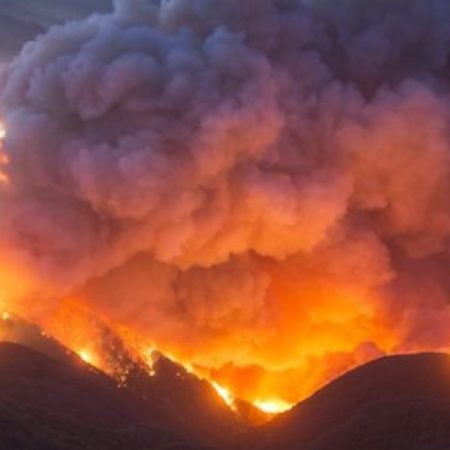
And then there is the looming climate catastrophe and the escalating levels of crippling anxiety it is producing. Jeremiah’s image of a boiling pot tipping towards us could be an image of catastrophic global warming, couldn’t it?
Some surveys have shown that three quarters of 16–25-year-olds say that the ‘future is frightening’ and over half believe ‘humanity is doomed’. If over half fear that humanity is doomed, is it any wonder that we are seeing epidemic levels of anxiety, despair, and mental health breakdown?
We are understandably afraid to acknowledge it and face up to the frightening reality of it, but it seems to me that our situation, our context, is not so different to Jeremiah’s after all. A widespread chronic reluctance to pay attention to the threats and contemplate what they mean was a part of his situation too. When threats are too big for us to have any personal ability to meaningfully respond, our instinct is to look away, pretend it is not happening, and just get on with life as though all was well.
So, if our situation is not so different from Jeremiah’s after all, then perhaps we can look to Jeremiah’s preaching for some guidance on how God might be calling us to live in the midst of these challenges. We’re going to have to look wider than tonight’s reading for this. We’re going to have to consider a bit of a snapshot of the whole book. From tonight’s reading we just get the little summary statement that says that through his preaching, Jeremiah is “to pluck up and to pull down, to destroy and to overthrow, to build and to plant.” Or in other words, Jeremiah’s message is not just to be one of doom and destruction, but one that offers something constructive and positive in the midst of that.
The temptation for us, as for the people of Jeremiah’s day, is to try to hurry on past the doom and destruction and focus only on the constructive, the positive, the hopeful. That can just become another form of denial, another way of sticking our heads in the sand. We listen only to the part of the message we like to hear. The times we are living in need better of us than that.
One thing to note about Jeremiah’s preaching that seems very relevant to our situation is that he doesn’t offer quick fixes. He doesn’t promise that if we all sort our recycling properly and install solar panels, that disaster will be averted. He certainly points out the history of failure and corruption that has brought us to the point of impending disaster, and he certainly urges us to change and eliminate those things, to get our act together now, but he doesn’t pretend that that is going to turn back the Assyrian and Babylonian armies. Disaster is already upon us.
That’s almost certainly true in the world we live in too. There are things we can and should do, but we’ve probably already passed the tipping points. The handful of people who have the money and power to really turn things around have mostly chosen to exploit the crises for even more money and power, rather than fix anything. So the question is no longer will there be a climate catastrophe. It is how bad will it be. The question is no longer will there be social and political breakdown and probably war. It is how widespread will it be, and how bad will it be, and will there be a way out.
So if Jeremiah’s message is not three easy steps to fix everything and avert disaster, what is it? What hope does he offer? What does he have to say to us in the world of social and political collapse and looming climate catastrophe that we have created?
Ultimately, what Jeremiah wants to remind us is that the call to live faithfully, to live out our covenant of all-inclusive love and compassion and generosity, was never premised on a promise that life would be comfortable, peaceful and prosperous. The call to follow in the way of Jesus always presupposed that we might be doing that in the face of injustice, persecution, and even crucifixion.
And so in the face of impending catastrophe, Jeremiah reminds us that our call remains unchanged, even if we be only a faithful remnant. We are still called to be the prophetic voice that bears witness to the truth that, no matter how bad things might get, there is much more that life can be than just the ugly prepper vision of barricading ourselves in our bunkers with a supply of ammunition to keep our neighbours from our dwindling survival rations.
We are still called to become people who embody the love and compassion and generosity of God, regardless of the trajectory of the world around us. We are still called to be people who perpetrate senseless acts of beauty all the more as a tide of ugliness and bitterness rises around us. We are still called to show the fragile light of the world, and all the more as darkness closes in.
Again, there is no denial in this, no sticking our head in the sand. One of the things Jeremiah models for us is heartfelt Godly lament. Jeremiah wrote the book of Lamentations too. The more people suffer, the more beauty is destroyed, the more community and relationships fracture and fragment, the more we raise a cry of lament for all the good that is lost and the pain that spreads.
But lament is not despair, and even in that lament is the call to be the alternative, to be the people who live out a way that doesn’t just fuel the ugliness. The lament goes hand in hand with a resilient joy that celebrates every sign of life, of beauty, of love, of goodness. We can be the people who hold tightly to those things and continue to rejoice in them, to nurture them, to bear witness that they still matter, perhaps now more than ever.
As Jeremiah, and the other prophets, and Jesus, and even the book of Revelation tell us, we are certainly not the first people to live under the threat of impending disasters. We are in good company, and our faithful forebears have shown us the way. The way remains the way of love, and compassion, and generosity, and mercy, given freely to all, even those who show us only hostility. This is the way of Jesus, and as Jesus has shown us, death and destruction will never have the last word. Powerful and terrifying as they may be, the Word of resurrection life is always ultimately a more powerful word.
And, like Jeremiah, from the womb we have been chosen and dedicated to be bearers and doers of that more powerful word.