Nathan has been a pastor of our Church since 1994.
God saves us by changing our hearts, but one of the great temptations for the church is to try to turn that back into a system of exclusion and control.

Nathan has been a pastor of our Church since 1994.
God saves us by changing our hearts, but one of the great temptations for the church is to try to turn that back into a system of exclusion and control.
Much of reality is usually hidden to us, but we can catch glimpses that become sustaining visions.
Although the Church and our nation might be stronger if they were more inclusive, the real call to inclusion is simply part of the call to faithfully reflect Christ.
Belonging to God does not exempt us from disasters that may come, although that is often what people hope and expect, but it does mean that they will not have the last word on us.
Like Mary, we are called to participate in God’s recreation and blessing of the world, and when we comprehend that call, we will, like Mary, explode with joy.
John calls us beyond insurance policy religion, but Jesus calls us still further into participation in God’s radical generosity to all the world.
God approaches us in an eager desire for communion, so our task is not to strive for communion, but simply to open ourselves to receive it.
God wants love rather than sacrifice, but in a fallen world love that is genuine will often be sacrificial.
In the sacraments, Jesus constantly calls us to follow him in giving up conventional notions of honour and offer ourselves for the life of the world.
Jesus’s abolition of “us” and “them” categories is so radical that it seems almost impossible for us to comprehend and put into practice.
It is human nature to think that our ways are God’s ways, and so to shun those whose ways seem alien or disgusting to us, but Jesus calls us to recognise God at work in others, however different.
In Christ we are one with all flesh and blood, and so our struggle is not against any other people, but against the spirits and powers and forces which would divide people and make them enemies.
If God seems unjust, we can and should question God’s integrity, for God welcomes our questions in order that the falsehoods might be stripped away and the truth revealed.
Jesus breaks down the barriers that divide us into pure and impure and removes the cause for the fear that marginalises people.
On our own we are powerless to deal with many of the things that confront us, but when we recognise that and make ourselves available for whatever God wants to do, all kinds of scary things may actually be possible.
Unquestioning allegiances to family and nation keep us bound to satanic systems, but Jesus binds the satan and breaks us free to be the new family of God.
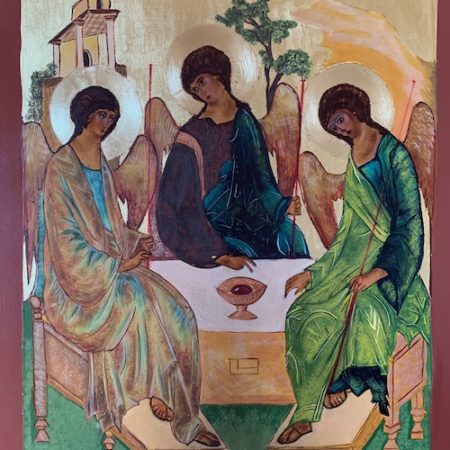
The vision of the Trinity reveals some of the most important characteristics of God: radical mutual love, radically open hospitality, and transformative engagement with the suffering of the world.
The Holy Spirit is poured out on us so that the liberating presence of Christ may be with us all everywhere, freeing us from fear to live and speak boldly of the new life we have tasted.
The Church is one body, sent into the world to live the life Jesus has begun, a life of love, reconciliation and mercy.
Jesus invites us into a new relationship with God and with one another based on love and friendship instead of power and rivalry.